The authors
who are informed on
acceptance of their abstract will find here a Template for the Full
Paper in
order to start working on the Final Paper. The deadline for the receipt
of
camera-ready full-length papers is set for
Authors should
allow sometime
for paper reviewing. Authors will be informed on the final acceptance
of their
paper by
The Official
Registration Form
contains all the practical information on payment arrangements and
methods. All
payments must be made by
All papers accepted for presentation will be edited and published in proceedings. Selected and best papers will be double-blind refereed and accepted papers will be published in special issues of the International Journal of Logistics Systems Management, Supply Chain Management: An International Journal, and the Journal of Manufacturing Technology Management.
For the Journal Guidelines please click here
 A Special Issue on
E-technology and Manufacturing Enterprise Competitiveness A
Special Issue on: “Logistics Systems Strategy in Global and Electronic
Markets” A Special
Issue on “Collaboration: The Key to Responsive Supply Chains” Supply Chain Management and
Logistics in South East Europe
A Special Issue on
E-technology and Manufacturing Enterprise Competitiveness A
Special Issue on: “Logistics Systems Strategy in Global and Electronic
Markets” A Special
Issue on “Collaboration: The Key to Responsive Supply Chains” Supply Chain Management and
Logistics in South East EuropeFinally, a handbook containing selected papers for specific key themes will be published.
Below you can download or view & print the template for the Full paper submission.
Full
paper Template (Miscrosoft Word) Full
paper Template (PDF)
Full
paper Template (PDF)A preview of the Full Paper template exists below.
[title
of the paper (use paper title style)]
[Author Name(s),
Affiliation(s), Address(es), Tel(s), Fax(s), E-mail(s), Website(s) -
use
AUTHORS Style]
Please mark by an * the author to whom correspondence should be addressed
Abstract
Using TEXT Style, enter a maximum of 150 words here.
Italic
Keywords:
Using TEXT Style, insert a
maximum of 6 words.
Title and Abstract guidelines
The title of paper should be 12 pt type size, 20 words max, title case, bold, centered as shown in above. The affiliation should be 10 pt type size, upper and lower case, normal, centered under the title.
Paper format
The paper length should not exceed 5000 words or 10 pages. Please use Times New Roman Fonts 10 pt size. The margins (right, top, bottom) are equal and must be set to 2.5 cm. The left margin should be set to 3.3 cm.
The main headings should be Arial 11 pt size, upper and lower case and bold. Be sure to use HEADING 1 Style. Any sub-headings should be Arial 11 pt size, upper and lower case and italic. Be sure to use HEADING 2 Style.
Please do not use any indentation while formatting your paper.
Artwork
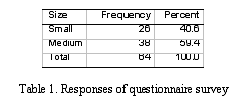
Figures and Tables: Minimum of 8 pt type size, minimum of line thickness at 0.30 mm, all captions should be upper and lower case, centered below the illustrations.
Photographs: Halftones, minimum of 8 pt type size, captions should be in upper and lower case, centered below the photographs.
All illustrations must be computer-designed and submitted as embedded images in your paper. Please do not submit colour images.
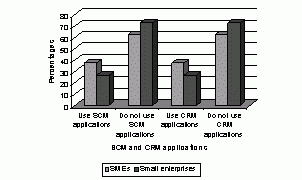
Figure 1. SCM and CRM applications in SMEs and small enterprises
The structure of the paper should follow the below-proposed structure:
1.
Introduction
In the introduction, clearly explain the nature of problem, background,
purpose and contribution of the paper.
2. Body of paper
Change the information on this document to contain the information you
would like. Usually, this section is the literature review.
3.
Research methodology
Discuss the methodology used.
4. Results, analysis and
discussions
Discuss your work.
5. Conclusions
Clearly indicate advantages, limitations, implications and possible
applications.
Acknowledgement
A brief acknowledgement section may be included.
References
[1] Chung, S. H. and Snyder C. A., 2000, ERP adoption: a technological evolution approach. International Journal of Agile Management Systems, 2(1), 24-32.
Proceedings Papers:
[2] Chung, W.W.C., Lau, H.C.W. and Lee, W.B., 2001, Management succession in the Internet age: a Chinese family-owned business perspective. Proceedings of International Conference on Supply Chain Management and Information Systems in the Internet Age (SCMIS 2001), Edited by Chung, W.W.C, and Gunasekaran, A. Published by Manufacturing Information Systems Research Unit, The Hong Kong Polytechnic University, pp.103-129.
Books:
[3] Slack, N., Chambers, S. and Johnston, R., 2001, Operations Management, 3rd edition, Prentice Hall.
Please find attached the Microsoft Word file and the PDF file of the Full Paper template
Full Paper Template (Microsoft
Word)Full Paper Template (Adobe PDF)
